Oct 20, 2026Strategy
The question is no longer whether you use AI, but where. Making your business future-proof starts with your processes, not with a tool, and with choosing per step between automation, AI and people.
"How can I use AI in my business?" Type "AI in my business" into Google and it immediately suggests questions like how to integrate AI into it. The honest answer does not start with ChatGPT, Copilot or a new software package, but with the way your business works. If you build AI into your processes instead of next to them, you make your company future-proof step by step, without turning everything upside down at once.
According to Statbel, just over a third (34.5 percent) of Belgian companies with at least ten employees used some form of AI in 2025. Among companies with more than 250 employees it is three in four. Across Europe you see the same gap: 17 percent of small enterprises use AI, compared with 55 percent of large ones.
More interesting is why companies that considered AI did not go ahead. Among European companies in that situation, Eurostat reports that 71 percent cite a lack of expertise, 53 percent unclear legal consequences and 49 percent concerns about privacy. Only 21 percent found AI not useful. So the question is rarely whether AI can help, but how to get started without taking risks.
The biggest mistake is treating AI as one thing you "roll out". Take a process and break it into steps. For each step there are three options:
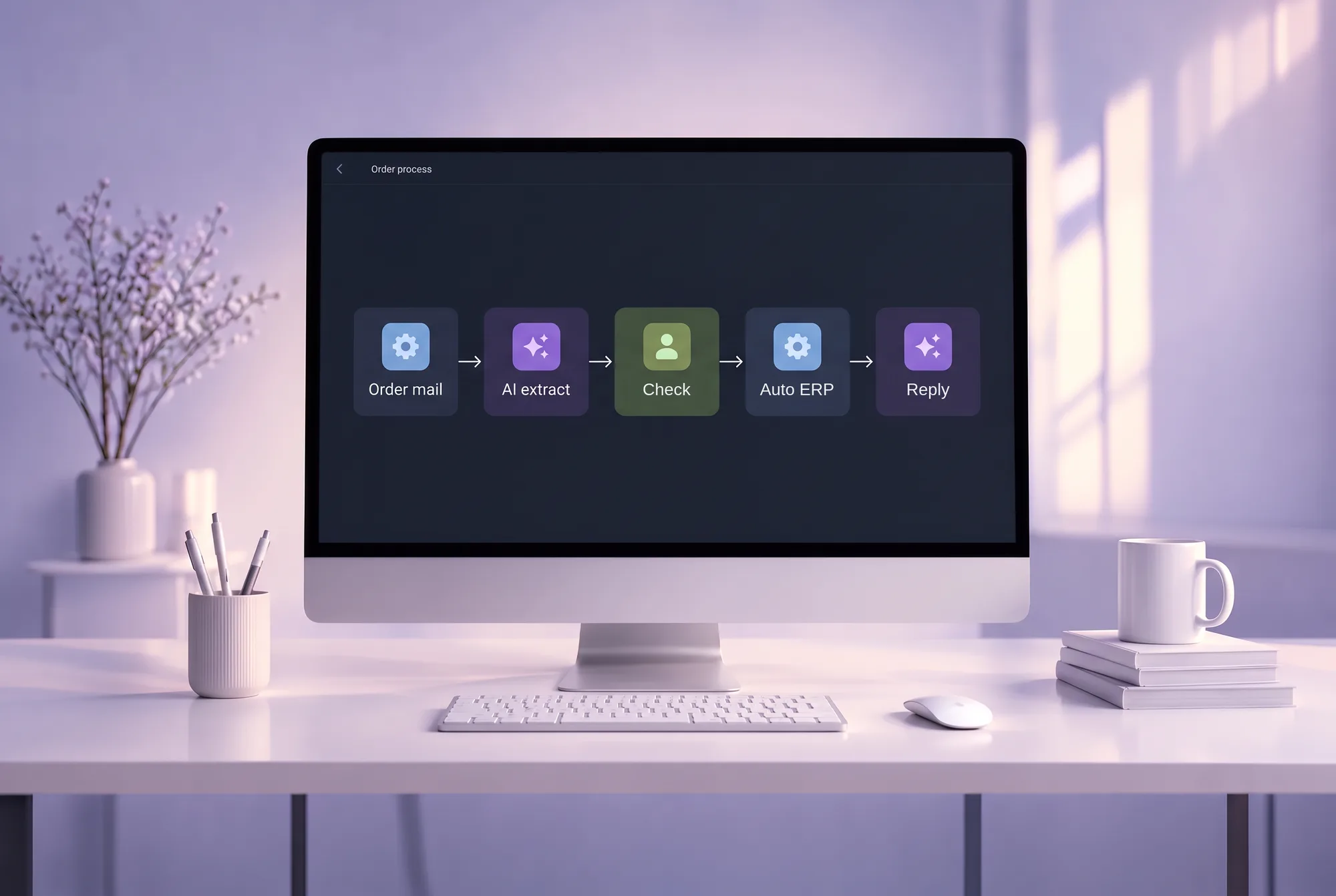
An example: a customer emails an order. AI extracts the items and quantities from the email, an automation enters them into order management, and an employee only looks at the orders that deviate. Nobody retypes anything, and people decide where it matters.
Research points the same way. In the global AI survey McKinsey published in March 2025, out of 25 factors examined, the redesign of workflows was most strongly linked to the bottom-line impact companies themselves attribute to generative AI. Yet only 21 percent of respondents whose organisations use generative AI said at least some workflows had been fundamentally redesigned.
The knowledge and integrations you build for the first process are reused in the second. Over time, that grows into a company brain.
Many Flemish SMEs look for subsidies first. Note that since 1 February 2026 the kmo-portefeuille (the Flemish SME wallet) only supports advice on cybersecurity. Training in certain future-oriented themes still qualifies (30 percent support for small and 20 percent for medium-sized enterprises, up to 7,500 euros a year) as long as the 2026 budget lasts. The Flemish government has decided to end the scheme on 1 January 2027. So look at what a process delivers, not at the subsidy.
We combine strategy and building in one team, without a product of our own to sell. That is why we do not start with the tool, but with your processes and your data, and choose per step what fits: a simple automation, AI, or just a better agreement between people. In everything we build, ordinary software calculates the numbers and AI only writes the assessment, so every result stays explainable. People stay in control, the knowledge remains yours, and the founders work on every project themselves.
How do I start with AI in my business? Pick one process that recurs often and takes a lot of time, map it, and decide per step whether automation, AI or an employee fits best. Measure the result before you expand.
What is the difference between automation and AI? Automation follows fixed rules and always gives the same result for the same input. AI can understand unstructured information such as emails and documents, but needs oversight. The best solutions combine both.
Can I get a subsidy for AI consulting? Not through the kmo-portefeuille anymore: since 1 February 2026 only cybersecurity advice qualifies, and the scheme ends on 1 January 2027. Training related to your professional activity does remain tax-deductible.
One conversation is enough to clarify your situation and decide the next step together. Free, and without obligation.