
Jul 7, 2026Automation
Why a system at full capacity isn't the most efficient, but the most fragile.
Every entrepreneur wants to use their people and resources to the fullest. Idle time feels like waste; a full calendar feels like success. Yet the mathematics behind queues – the same that explains why a hospital's emergency department or a motorway grinds to a halt – teaches something counter-intuitive. A system that fully uses its capacity isn't the most efficient system. It's the most fragile. Those who understand this plan differently, automate differently and promise differently to their customers.
There's a deep intuition in entrepreneurship that unused capacity is lost money. A consultant who isn't billing, a machine standing still, an employee with 'nothing to do' – it all feels like a leak in the bucket. That intuition pushes companies towards maximum occupancy. Schedules are filled tightly, margins on time disappear, and an occupancy rate above ninety percent counts as a sign of sound management. The reasoning seems irrefutable: the fuller the system, the more value comes out of it.
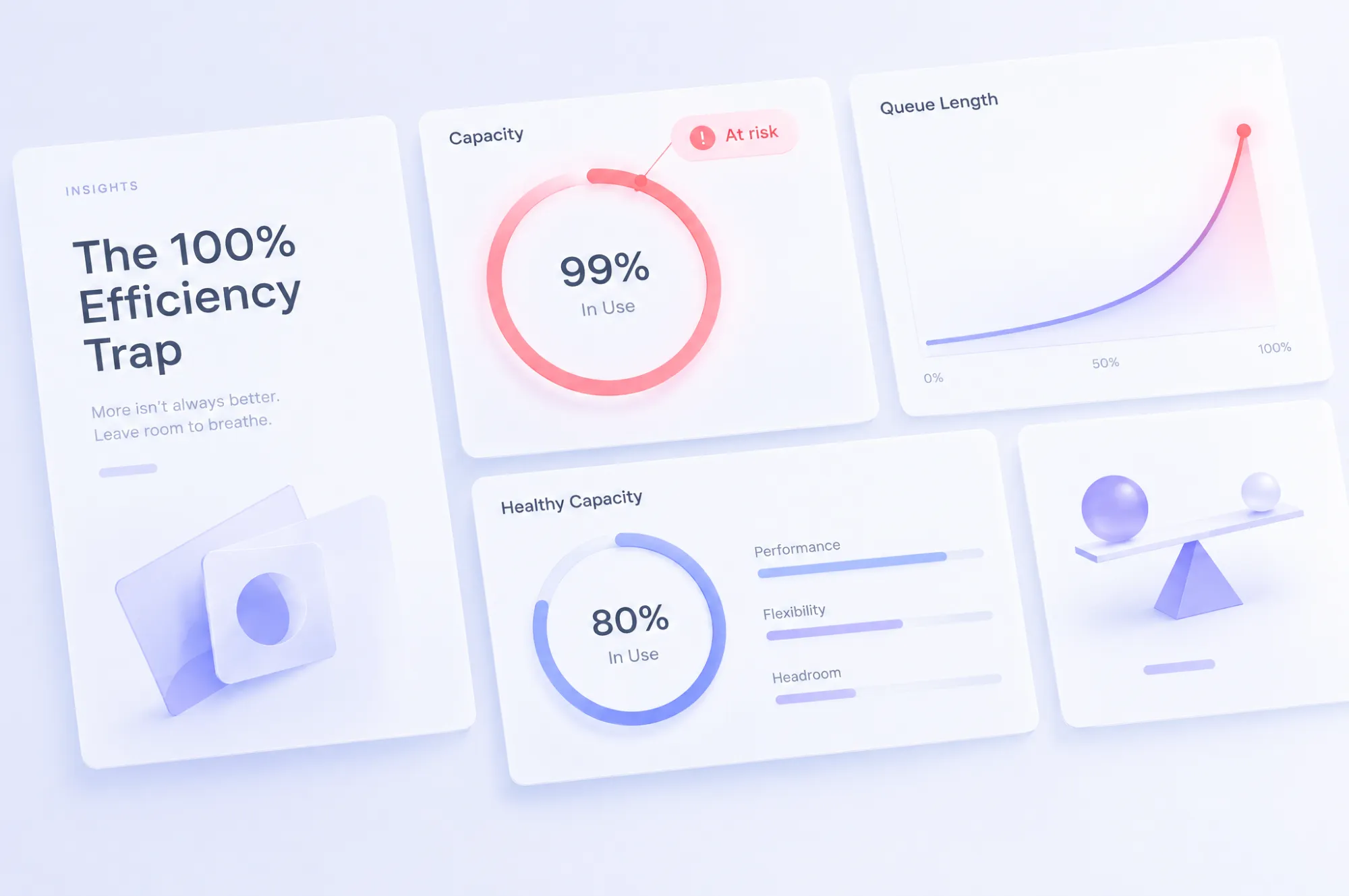
Queueing theory, developed by the Danish engineer Agner Erlang to dimension telephone networks, shows something that runs against that feeling. As a system's occupancy rate rises towards a hundred percent, waiting time doesn't rise gradually with it – it shoots up exponentially. At seventy percent occupancy there's still breathing room. At eighty-five percent it starts to pinch. At ninety-five percent every small hiccup turns into a jam that reverberates for hours or days. The reason is that variability – an urgent order, a sick colleague, a customer who delivers late – has to be absorbed somewhere. In a system without slack there's nowhere to absorb that shock, so it propagates through the entire chain.
Everyone knows the phenomenon of the road. In moderate traffic everything flows. Add ten percent more cars and traffic doesn't slow by ten percent – it comes to a standstill. Exactly that happens in a company running at full capacity. One delayed file pushes the next aside, which in turn hits the one after. Waiting times pile up, people start firefighting, and the organisation feels chronically overloaded while the numbers say everything is 'utilised'. The jam isn't the result of too little capacity, but of too little slack.
This leads to a re-evaluation of something most efficiency thinkers cut away: buffer. Unused capacity isn't waste but the price you pay for predictability and speed. A system with deliberately built-in breathing room can absorb shocks without the customer noticing. Toyota built an entire production philosophy on this – not maximally loaded, but flowing and stable. The paradox is that the system with the lower occupancy often achieves more throughput over time, because it doesn't keep grinding to a halt and having to recover.
Here lies a connection that's often missed. The greatest gain from automation isn't in speeding up the average case, but in absorbing variability. Software doesn't get sick, doesn't go on holiday, and processes a spike of a hundred requests as patiently as a single one. By removing repetitive, predictable actions from people, you give those same people back the slack to handle the exceptions where judgement is genuinely needed. Automation, in other words, creates buffer without it costing money in idle time. It lowers the effective occupancy rate of your people on precisely the tasks that make the system grind to a halt.
A subtle but crucial point: customers never experience your average lead time. They experience the spread. A company that on average delivers quickly but occasionally overruns badly is remembered for those outliers. Predictability is therefore often commercially more valuable than speed. A supplier who always delivers within three days is more reliable than one who usually delivers within one day but sometimes within ten. Reducing variability – through buffer and automation – is thus not only an operational choice, but a brand promise.
The lesson isn't that idle time is good. The lesson is that a hundred percent occupancy is an arithmetic error that only bites at the moment you can't afford it. The strongest organisations deliberately plan below their maximum, use automation to remove variability, and treat slack as a strategic asset rather than a cost. Strategoo helps companies design that breathing room: we map where your system runs up against its ceiling, automate the predictable flows that clog your people, and build processes that absorb shocks instead of passing them on. So your business grows not busier under growth, but more stable.
One conversation is enough to clarify your situation and decide the next step together. Free, and without obligation.